We are launching Taxonomy Tales, a new TETTRIX series of stories about the people and the science behind the discovery of life on Earth. Our first guest is Emily Hartop, Associate Professor of Integrative Taxonomy and Phylogenetics at the Norwegian University of Science and Technology (NTNU) and Co-Lead of the CETAF Scientific Research Group. On Wednesday, 4 November 2026, at 10:00-10:30, Emily will deliver the plenary talk “The Barcode Is Just the Beginning: Dark Taxa and the Next Chapter of Biodiversity Science” at the 10th International Barcode of Life Conference (iBOL 2026) in Bangkok, Thailand.
Ahead of her talk, Alexandra Tzvetkova (AT) from Pensoft spoke with Emily about inspiration, scuttle flies, changing your mind in science, and why the hidden majority of biodiversity may be rewriting the ecological picture.
AT: Emily, many people picture taxonomy as quiet, solitary work behind a microscope. How did you find your way into it?
EH: Honestly, I didn't set out to become a taxonomist, and I'm certainly not quiet and solitary! I was always fascinated by insects and their microscopic world, but what really hooked me into taxonomic research was the detective work. You have this tiny organism (or many tiny organisms!) in front of you and you're trying to reconstruct its identity from morphology, geography, ecology, history, and DNA. It's a puzzle, but the answer isn't sitting in the back of the book. Amazingly, you sometimes discover that nobody has ever described the thing you're looking at!
Taxonomy is often portrayed as putting names on things, but I see it much more as discovering what is actually out there and giving other scientists a way to find it, study it and talk about it. And once you start looking at insects at the scale I do, you realise very quickly that the planet is full of organisms we haven't even properly begun to understand.
AT: You’ve described sorting more than 43,000 scuttle flies in Los Angeles, specimen by specimen. What qualities other than the obvious patience should a person have to do this? What did that experience teach you about yourself as a scientist?
EH: Patience is definitely necessary, but I think curiosity is more important (and perhaps a healthy dose of obstinacy and an affinity for caffeine!). You have to be able to look at the same tiny, seemingly unremarkable fly for the hundredth time and still think, hang on...is this one different?
That experience taught me that I'm much more interested in patterns than I realised. When you're sitting there with 43,000 individual flies, you eventually stop seeing 43,000 individual flies and start seeing distributions, communities, abundance and geography. I realised that the real prize wasn't just knowing what each specimen was. It was being able to ask what all of them, together, could tell us about biodiversity.
AT: How do you explain DNA barcoding to your friends who are not scientists?
EH: I usually say it's a bit like giving every organism a barcode like you would have on something you buy in a shop, that can be read and lets us recognise it quickly. The difference is in the shop it's a graphic with little bars, in DNA barcoding we read the nucleotides of DNA.
The great thing about DNA barcoding is that if I have 10,000 tiny flies that all look extremely similar, I can use their DNA to sort them into groups and then go back and ask what those groups actually represent. And that's where I think people sometimes misunderstand barcoding. The barcode isn't the end of the story. It's a really powerful way of getting through the front door. Once you've sorted the diversity, you can start asking much more interesting questions about morphology, ecology, evolution and behaviour.
So I sometimes describe it as giving biodiversity a first pass through the scanner. The exciting part is what you do with the information afterwards.
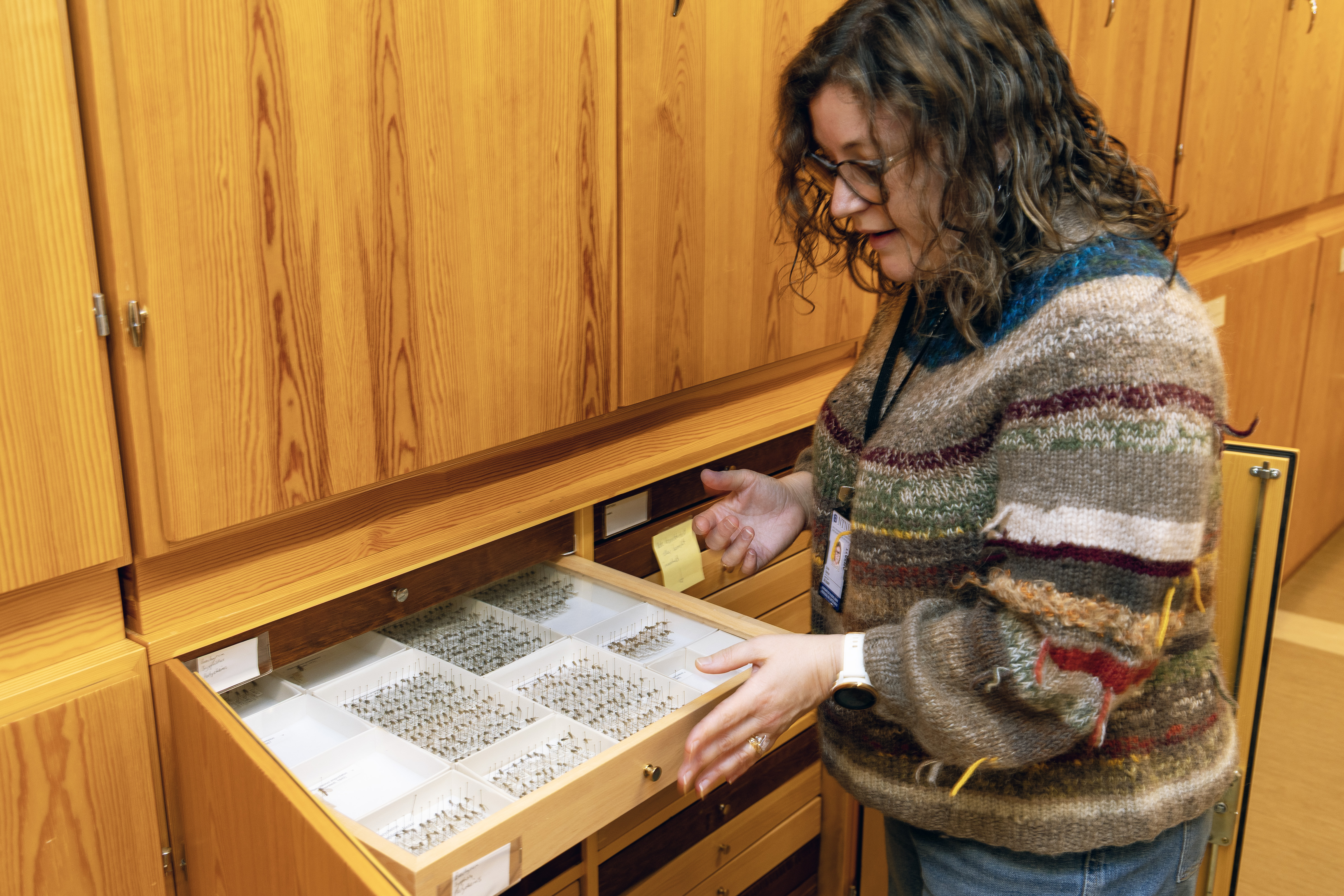
AT: What do you think should teachers explain to 10-12 year-old kids at school about dark taxa?
EH: That scientists don't actually know everything that's alive on Earth (not even close!) and that some of the most important organisms are the ones we pay the least attention to. These species are usually small and don't immediately capture our attention that way that lions, elephants, butterflies and birds might - but even flies are beautiful once you take a closer look, and their extreme diversity makes them fascinating in a way the better known creatures never will be.
And I'd really emphasise that not knowing isn't a failure of science. It's an invitation. There is still an enormous amount left to discover.
That's one of the things I love about dark taxa. You can look at a handful of tiny flies and genuinely say, we don't know what these are, we don't know how many species there are, and we don't know what they're doing in the ecosystem. That's not a depressing message for a ten-year-old. That's an incredible job description and world of opportunity.
AT: Your iBOL talk calls for integrating molecular data with morphology, natural history collections, imaging, machine learning and community science. TETTRIX starts from the idea that technology accelerates the workflow but only expertise makes it trustworthy. In your experience, where does human taxonomic judgement remain irreplaceable as AI and automation scale up?
EH: I don't think the goal of automation should ever be to remove taxonomists from the workflow. The goal is to let taxonomists spend their time on the parts that actually require expertise.
A machine can become extraordinarily good at recognising a pattern if you give it enough examples. It can measure a wing, sort images, cluster sequences and flag specimens that look unusual. What it can't reliably do is understand the biological meaning of an unexpected pattern without the context we've accumulated through taxonomy, natural history and collections.
And actually, I think the more automation we introduce, the more important expert judgement becomes at certain points. If a machine gives you 100,000 species hypotheses, someone still has to ask: what are these? Are they biologically meaningful? What evidence supports them? Are we looking at cryptic species, geographic variation, poor sampling, hybridisation, sequencing artefacts?
So I'm very pro-automation, but I'm not pro-automation-for-automation's-sake. I want machines to do the repetitive things they're brilliant at so that humans can concentrate on the genuinely interesting (and fun!) parts of science.
AT: As Co-Lead of the CETAF Scientific Research Group, you work across Europe’s natural science collections community. What would a truly integrated European taxonomic system make possible that today’s scattered resources cannot? What role do collections play?
EH: At the moment, Europe has an extraordinary amount of taxonomic expertise, data and physical specimens, but a lot of it is distributed across institutions, countries and different systems. The frustrating thing is that the pieces are there but we're just not always able to make them behave like one scientific resource.
A truly integrated system would allow us to connect those pieces: specimens, names, images, DNA sequences, ecological observations, expertise and historical collections. That would change the scale at which we could do taxonomy.
And I think collections are absolutely central to this. A natural history collection isn't just a warehouse of dead organisms. It's a physical record of biodiversity through time. If we can connect those specimens to modern molecular data and digital information, suddenly a specimen collected 100 years ago can become part of a question we're asking today.
For me, that's one of the most exciting possibilities: not replacing collections with digital data, but making the collections infinitely more useful by connecting them to everything else.
AT: Taxonomy needs new generations of experts, and the field is changing fast. What would you say to a student or early-career researcher wondering whether taxonomy could be their path? Which skills or habits of mind would you encourage them to build?
EH: Absolutely do it, but don't think of taxonomy as a narrow career where you spend your life doing exactly what taxonomists did 50 years ago.
The really exciting thing about taxonomy now is how many different skills you can bring into it. You can be interested in morphology, genetics, imaging, AI, ecology, informatics, collections, field biology...and the most interesting work happens where those things meet.
I would encourage students to become really good at something, but also to stay curious about the things outside their speciality. Learn to look at a specimen. Learn some molecular biology. Learn to handle data. Learn how collections work. And, perhaps most importantly, learn to tolerate not knowing the answer because taxonomy is fundamentally a science of discovery. You are going to encounter things that don't fit. That's not an inconvenience, that's usually where the fun begins.
And honestly, there are few scientific fields where you can still look at something and genuinely say, we didn't know this was here. That's a pretty wonderful way to make a living.
AT: The publication you are most proud of?
EH: I'd probably choose our paper from the Los Angeles BioSCAN project where we described the first 30 new species from the project, which we called Opportunity in our ignorance. At the time, the title was really about recognising how much biodiversity we still didn't know. What I find funny now is that I had absolutely no idea the enormity of opportunity we were looking at.
That project eventually led me into large-scale DNA barcoding, ecological modelling, portable sequencing, machine learning and automated morphology, and ultimately into a much bigger question about how we actually do biodiversity science when the organisms we're studying are overwhelmingly dark taxa. So I like the paper not because it's necessarily the most important thing I've published, but because, in retrospect, it feels like the beginning of a much bigger story. We thought we were documenting our ignorance, but we really had no idea just how little we knew. Link to paper: https://mapress.com/zt/article/view/zootaxa.3941.4.1
AT: Your favourite book in connection to science?
EH: The Fly Trap by Fredrik Sjöberg. It is probably the most beautiful book I've ever read about flies - and about Rene Malaise, the Swedish entomologist who invented the Malaise trap. It's set on a little Swedish island where Sjöberg spends his time collecting hoverflies, and it captures something I love about entomology: the combination of obsessive curiosity, natural history and a slightly ridiculous willingness to spend your life looking for tiny things.
In fact, that book was one of the inspirations for me to move to a Swedish island myself, studying my own flies! So I suppose it's fair to say that both publications have shaped my life.
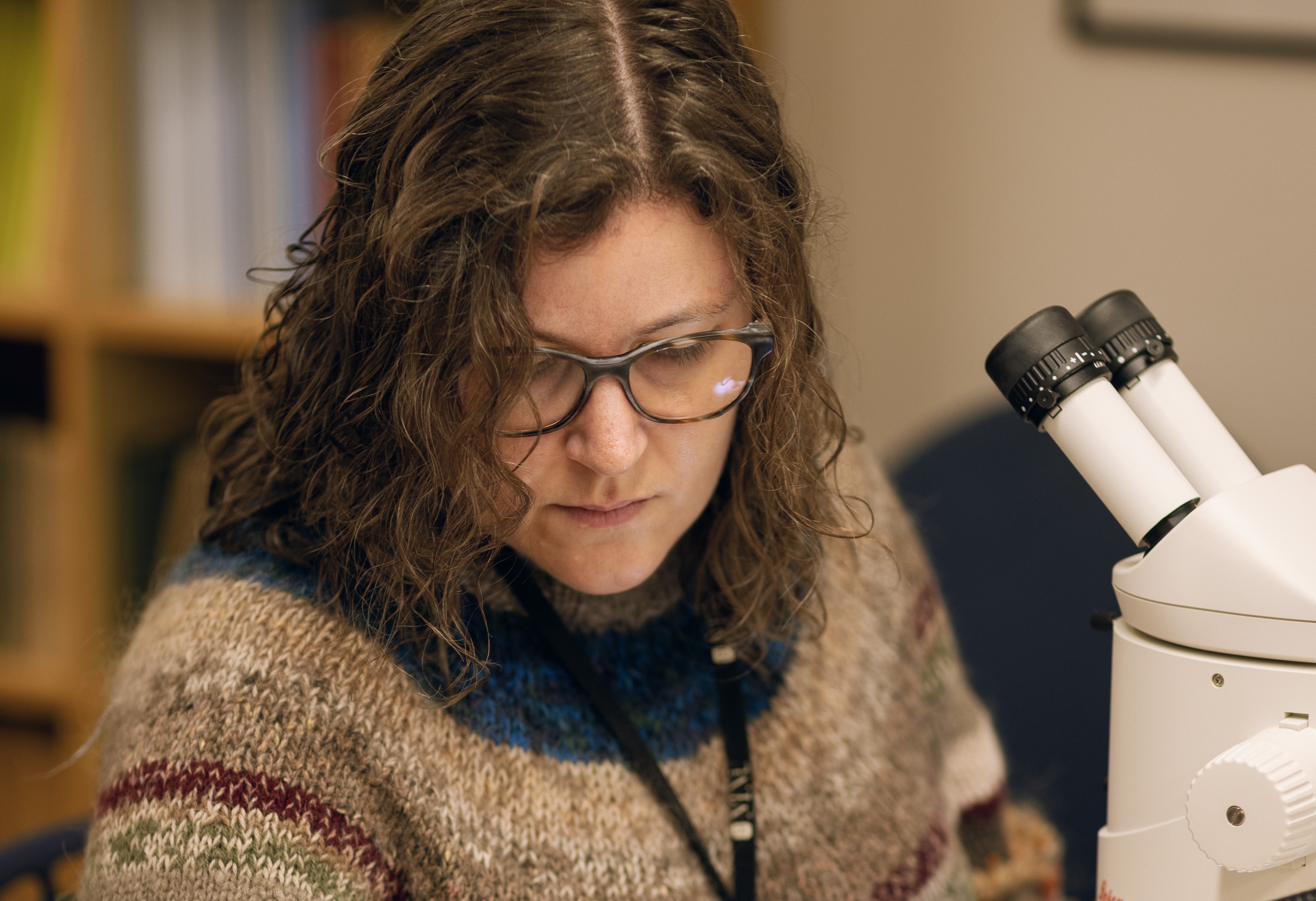
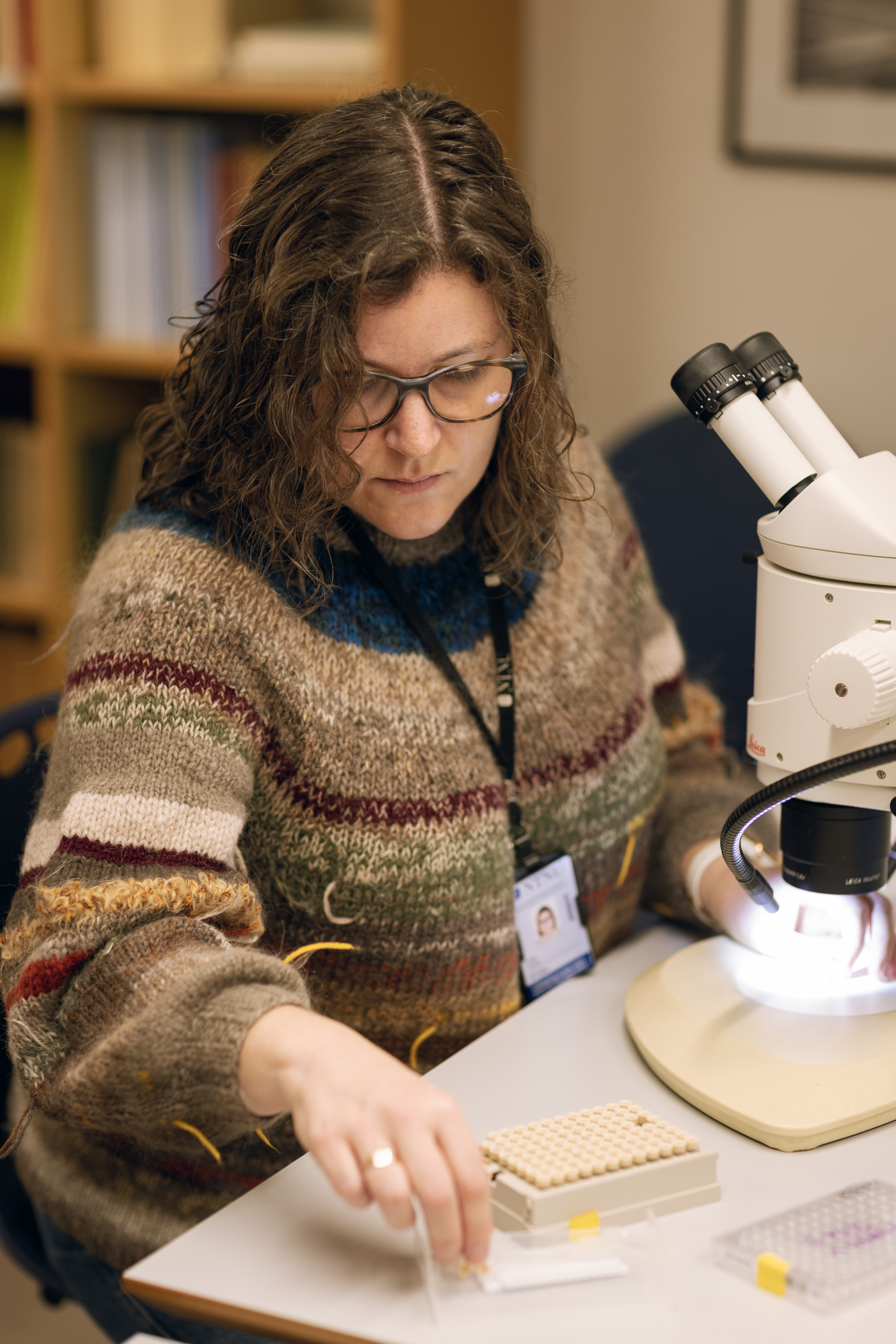 | Emily Hartop is an Associate Professor of Integrative Taxonomy and Phylogenetics at the Norwegian University of Science and Technology (NTNU). Her research focuses on accelerating biodiversity discovery through integrative taxonomy, combining genomics, morphology, imaging, artificial intelligence, and bioinformatics to document Earth's most diverse and understudied organisms. She is particularly interested in "dark taxa" - hyperdiverse groups that remain largely unknown to science - and in developing scalable, open workflows that make biodiversity research faster, more accessible, and more reproducible. Emily leads and contributes to several international initiatives advancing biodiversity science and infrastructure, including projects focused on DNA barcoding, taxonomy, and biodiversity informatics. She also serves as Co-Lead of the CETAF Scientific Research Group (SciReg), where she works to promote collaboration and innovation across the European natural science collections community. |
Subscribe to the TETTRIX Newsletter for more stories like this one!